When a bespoke client in Mayfair or a couture house in Paris commissions a garment encrusted in three-dimensional bullion, the needle rarely pierces fabric in Europe. The true genesis of this metallic alchemy happens thousands of miles away, in the labyrinthine bylanes of Lucknow and Bareilly. Here, the art of Zardozi—the weaving of gold and silver threads—is not merely a profession; it is a generational inheritance.
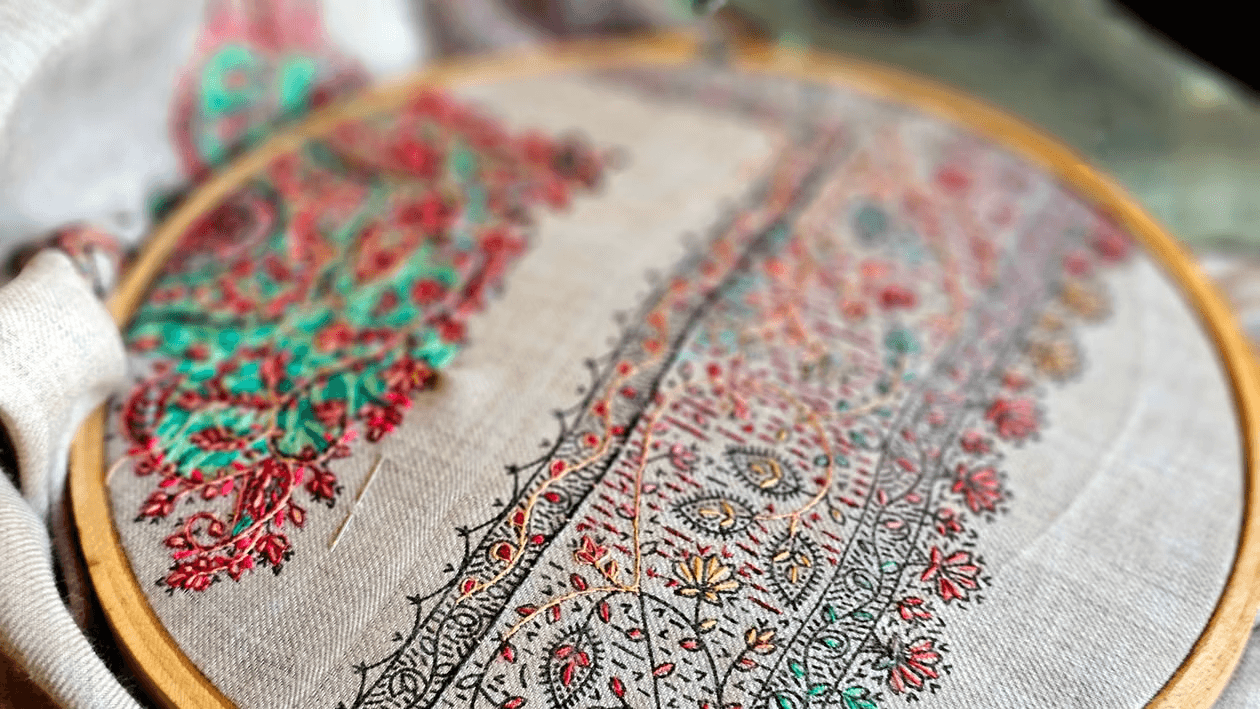
cc: image by vaishno
The rhythmic thud of the adda (the wooden embroidery frame) provides the heartbeat for these workshops. Artisans, often sitting cross-legged for up to ten hours a day, wield the aari (a fine, hooked needle) with surgical precision. The process is painfully slow. To execute a single, heavily embroidered bespoke jacket lapel, a master zardozikar might spend upwards of 120 hours meticulously securing coiled wires (dabka), sequins, and silk threads.
What is shifting in 2026 is the recognition. For decades, these artisans were the invisible engine of the global luxury machine. Now, elite bespoke clients are demanding absolute transparency, insisting on knowing the provenance of their embroidery. The modern Zardozikar is no longer an unnamed contractor; they are recognized as the master engineers of wearable art, translating raw metallic wire into breathing, flexible armor.