To the untrained eye, the white-on-white embroidery crowding commercial boutiques might pass as Chikankari. But to the bespoke purist, these machine-rendered facsimiles are a tragedy. True Awadhi Chikankari is a whisper of a craft, a symphony composed of 32 distinct, recognized stitches, each with its own purpose, tension, and architectural role.

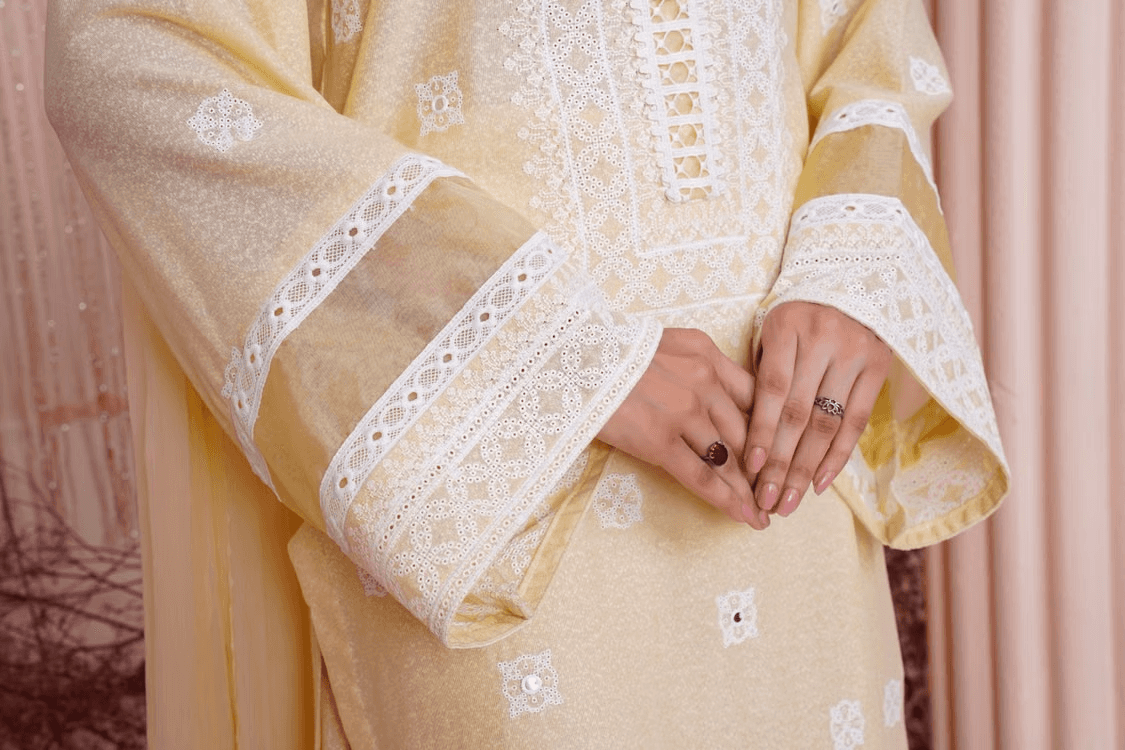
The true hallmark of a bespoke Chikankari commission is the mastery of the Bakhiya, or shadow work.
The Anatomy of True Shadow Work:
The Reverse Technique: Unlike standard embroidery, the artisan executes the herringbone stitch on the underside of the translucent fabric (traditionally fine muslin, organza, or georgette).
The Illusion: On the right side of the fabric, the thread outlines the motif in a microscopic running stitch, while the heavy thread underneath creates a soft, opaque shadow that seems to bloom from within the textile itself.
The Tension: A master artisan achieves perfectly uniform tension. If pulled too tight, the delicate fabric puckers; if too loose, the shadow loses its definition.
When evaluating a bespoke piece, one must look for the distinct variations in the stitches—the raised knots of Murri, the delicate netting of Jali (achieved by teasing the warp and weft apart, never by cutting the fabric). The presence of slight human irregularity is not a flaw; it is the ultimate proof of life, the signature of hands that refuse to be replaced by machines.